Your pre-money valuation decides how much of your company you sell when you raise. This guide explains pre-money and post-money valuation, how to calculate them, how pre-seed valuations are really set, and why the highest number isn't always the best deal.
What is pre-money and post-money valuation?
Pre-money valuation is what your company is valued at immediately before new investment comes in. Post-money valuation is the pre-money valuation plus the new money raised.
Post-money valuation = pre-money valuation + amount raised
The new investors' share of the company is the amount they invest divided by the post-money valuation, not the pre-money. That's the number that tells you how much you've given away.
How to calculate pre-money and post-money valuation.
Say you raise £500,000 at a £2m pre-money valuation, and the founders own all 1,000,000 shares before the round.
| Step | Calculation | Result |
|---|---|---|
| Post-money valuation | £2m + £500k | £2.5m |
| New investors' share | £500k ÷ £2.5m | 20% |
| Founders' share after the round | £2m ÷ £2.5m | 80% |
| Price per share | £2m ÷ 1,000,000 shares | £2.00 |
| New shares issued | £500k ÷ £2.00 | 250,000 |
The price per share comes from the pre-money valuation, because that's the value of the shares that already exist. New shares are issued at that price, and the total grows from 1,000,000 to 1,250,000.
It works backwards too. If you know you're raising £500k and want to give away no more than 20%, the post-money valuation has to be at least £2.5m, so the pre-money has to be at least £2m.
Our pre-money valuation and dilution calculator does these sums for you, including option pools and ASAs, and gives you the cap table as a download.
How pre-seed valuations are set.
At pre-seed there's very little to value a business on: little revenue, often no profit and only an early product. So a pre-seed valuation isn't calculated in the way a later-stage company's might be. It's a negotiation.
That negotiation mostly comes down to two numbers: how much the founders need to raise, and how much of the company they're willing to give away for it. Most founders give away between 10% and 20% at pre-seed, sometimes up to 25%. Once the raise and the dilution are agreed, the valuation follows from them.
Market norms play a part too. Investors compare against rounds they've seen at a similar stage and in a similar sector. In the UK, most traditional pre-seed rounds are valued under £5m pre-money, and often under £3m, though deep tech and exceptional teams can go much higher. Good data is hard to get without tools like Beauhurst, but accelerators and investors you trust can usually tell you what's typical.
UK pre-money valuations by stage
Beauhurst's tracking of UK equity deals gives a useful benchmark. In the first half of 2026, median pre-money valuations by stage were:
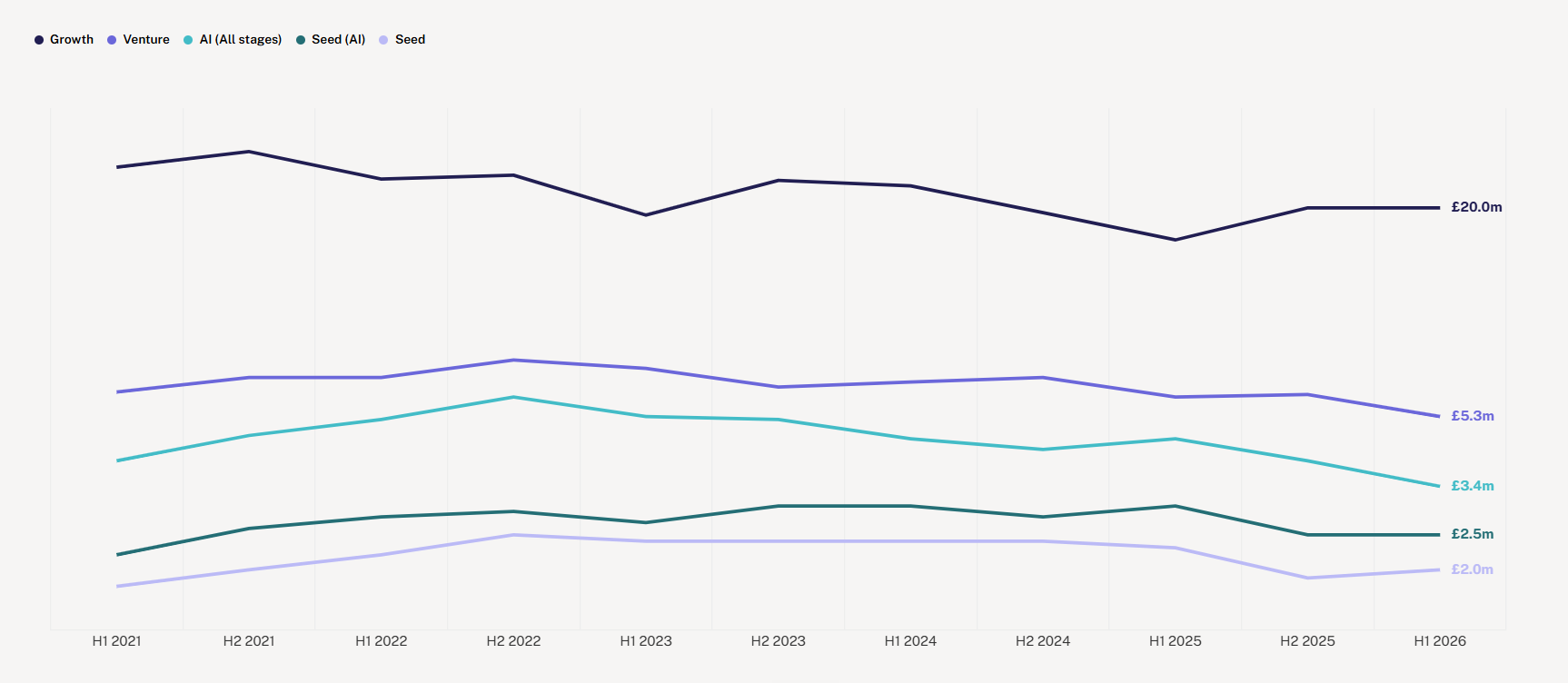
| Stage | Median pre-money valuation, H1 2026 |
|---|---|
| Seed | £2.0m |
| Seed, AI companies | £2.5m |
| AI, all stages | £3.4m |
| Venture | £5.3m |
| Growth | £20.0m |
Beauhurst's seed stage covers young companies with a small team, a low valuation and uncertain product-market fit, so it includes most pre-seed and early seed rounds. Its venture stage covers companies a few years old with significant traction and valuations in the millions, which is closer to later seed and Series A.
Seed-stage valuations have moved within a fairly narrow range since 2021, so the £2m figure isn't a blip. AI companies raise at a premium at every stage. If you're planning a pre-seed round in the UK, £2m is a sensible place to start thinking, with the team, traction and competition for the round moving you up or down from there.
If you're not sure what's reasonable, it's better to be open about it. A lot of founders arrive with a number in mind but no real read on what's normal, often anchored on big rounds they've seen announced. A sensible conversation about what you need and why usually goes further than a number you can't support.
Often the lead investor will propose the valuation, which you can then negotiate. Opening with a valuation that's too high can get you a quick no.
What pushes a pre-seed valuation up or down.
- The team. Early-stage investing is a game of outliers, and investors are mostly backing the founders. The more convincing the team, the more they can ask for. Prior startup success, deep sector experience and evidence of moving fast all count.
- Competition for the round. If several investors want in, the valuation tends to rise. A round that has to be pushed over the line tends to price lower.
- Traction. Customers, revenue and a launched product reduce the risk, and investors will pay more for less risk.
- The market. A large market with room for a big outcome supports a higher valuation. A small one caps it, however good the business.
- Sector. Some sectors, such as deep tech, often raise at higher valuations because the rounds are larger and the potential outcomes bigger.
On the other side, little progress for the time and money already spent, a messy cap table or a round that's struggling to fill will all pull a valuation down, or make a deal unworkable.
Option pools: who takes the dilution.
An option pool is a block of shares set aside for future employees. Investors often ask for one to be created, or topped up, as part of the round.
When an investor asks for a pool as part of the round, it's almost always created before their money goes in, so the existing shareholders take all of that dilution, not the new investor. In effect, a pool lowers the real pre-money valuation for the founders.
Using the example above, if the investor asks for a 10% option pool on top of their 20%, the founders end up with 70%, not 80%. The headline valuation stays the same, but the founders own less of it.
So when you compare offers, look at what you'll own after the round, including any pool, not just the valuation. The dilution calculator shows both.
ASAs, SAFEs and your valuation.
An Advance Subscription Agreement (ASA) in the UK, or a SAFE elsewhere, lets investors put money in now and receive shares later, when you raise a priced round. Neither sets a valuation on the day the money goes in.
Instead, they usually convert at a discount to the valuation of the next priced round, often 10% to 20%, and sometimes with a cap, a maximum valuation they'll convert at. So the valuation you agree in the priced round still matters most: the discount and cap are applied to it.
There's one thing to watch. If the ASA or SAFE money is a large part of the priced round, it can shape the negotiation. An investor leading the priced round may anchor on the cap, or on what the early money effectively paid, rather than starting fresh. The bigger the share of the round that's already committed on those terms, the more it can pull the valuation towards them.
The dilution calculator shows how ASAs and SAFEs convert in a priced round, including discounts and caps.
Why the highest valuation isn't always the best deal.
It's natural to want the highest valuation you can get. But the number is only one part of the deal, and chasing it can cost you more than it saves.
The right investor matters more
A great investor helps a business grow: with introductions, hiring, the next round and the hard decisions in between. A slightly better valuation from an investor who's difficult to work with is rarely worth it. Prioritise the right investor over the best price.
It sets the bar for your next round
Your next investors will want to pay more than the last ones did, so a high pre-seed valuation raises the bar for what you need to have achieved by then. If the business hasn't moved on far enough, that can put them off, and a flat or down round is painful for everyone.
Watch for unusual terms
A high headline valuation sometimes comes with structures that aren't normal at this stage: liquidation preferences, warrants, or other terms that give an investor extra protection or compensate for a higher valuation. They can make the valuation look better than the deal really is. They also put off future investors, who don't want to invest behind unusual terms. A clean, standard deal at a fair valuation is usually worth more.
Finding the right valuation.
There's no perfect number. The aim is the right deal: enough money to reach your next milestone, from investors who'll help you get there, at a dilution that keeps your cap table sensible for the rounds that follow.
For more on raising your first round, read our guides to pre-seed funding and SEIS and EIS, and model your round in the dilution calculator.
Questions founders ask.
Pre-money valuation is what the company is worth immediately before new investment. Post-money valuation is the pre-money valuation plus the amount raised.
Add the amount raised to the pre-money valuation. Raising £500k at a £2m pre-money valuation gives a post-money valuation of £2.5m.
Divide the amount they invest by the post-money valuation. £500k invested at a £2.5m post-money valuation buys 20% of the company.
Beauhurst's figures put the median UK seed-stage pre-money valuation at £2.0m in the first half of 2026, and most traditional pre-seed rounds are under £5m. The team, traction and competition for the round move it up or down.
Mostly by negotiation, based on how much the founders need to raise and how much they're willing to give away, typically 10% to 20%. The team, competition for the round, traction and market norms all play a part.
Yes. When a pool is created as part of the round, existing shareholders usually take all of the dilution, so the founders own less than the headline valuation suggests.